

The Constitutional Case for Secession

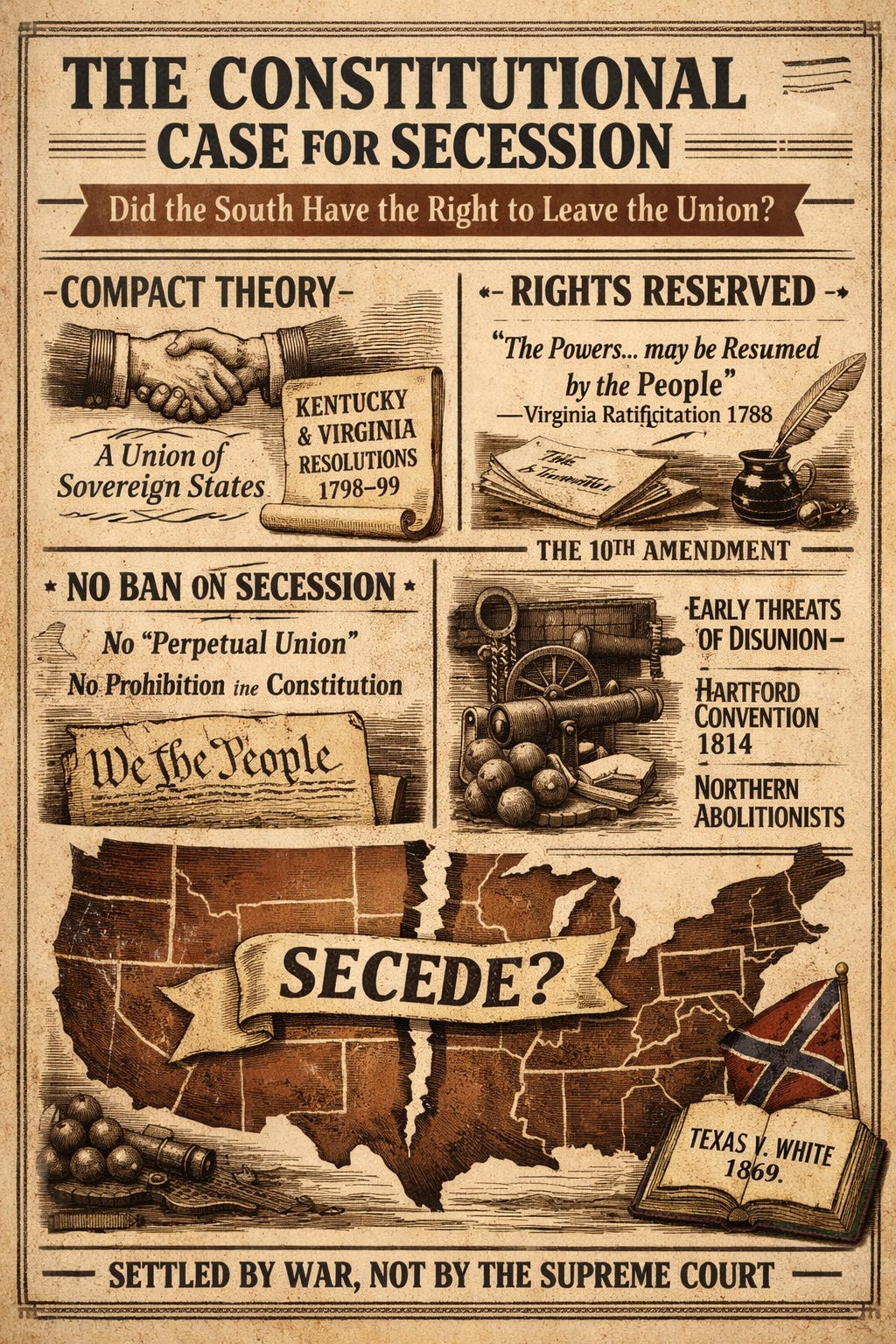
Why the Southern States Asserted a Lawful Right to Leave the Union in 1860–61
⸻
Introduction: A Question Settled by War, Not by Text
Few questions in American history generate as much heat—and as little careful constitutional analysis—as the issue of secession. The prevailing modern claim is categorical: the Southern states had no right to leave the Union. This conclusion is often treated as self-evident.
It is not.
The American Civil War resolved the issue of secession militarily, and Reconstruction resolved it jurisprudentially. But at the moment of secession in 1860–61, the United States Constitution did not contain a clear textual prohibition against withdrawal, nor had the Supreme Court ruled such an act unconstitutional.
This article advances a narrow but historically grounded claim:
That the Southern states asserted a plausible constitutional right to secede under the legal doctrines and understandings prevailing before the Civil War.
This is not a defense of slavery, nor an endorsement of secession as moral or prudent. It is an examination of constitutional arguments as they existed before the outcome was decided by force.
⸻
I. The Constitution as a Compact Among Sovereign States
The foundation of the Southern argument was the compact theory of the Constitution—the idea that the federal government was created by sovereign states through a voluntary agreement, delegating limited powers while retaining ultimate authority.
This was not a fringe doctrine. It was articulated by Thomas Jefferson and James Madison in the Kentucky and Virginia Resolutions of 1798–99. Those resolutions asserted that:
• The federal government is a creation of the states
• Powers not delegated are reserved
• States may judge unconstitutional federal actions
At the time, these views were debated—but not dismissed as illegitimate or treasonous.
⸻
II. Ratification: The Union Was Entered Voluntarily
The Constitution was not ratified by a single national electorate. It was ratified state by state, through sovereign conventions.
Crucially, several states ratified with explicit reservations.
Virginia (1788)
Virginia declared that powers granted under the Constitution could be “resumed” by the people of the state if abused.
New York and Rhode Island
Both issued similar declarations reserving the right to reassume delegated powers.
These reservations matter. They demonstrate that at least some states understood the Union as conditional—based on continued consent.
⸻
III. The Tenth Amendment and Reserved Powers
The Tenth Amendment states:
“The powers not delegated to the United States by the Constitution, nor prohibited by it to the States, are reserved to the States respectively, or to the people.”
Southern constitutionalists argued:
• Secession is not a delegated federal power
• Secession is not prohibited to the states
• Therefore, it remains within the sphere of reserved sovereignty
Opponents countered that secession was incompatible with the Constitution’s structure—but this was an interpretive claim, not a textual one.
⸻
IV. No Explicit Constitutional Ban on Secession
The Constitution does not include:
• The word perpetual
• A clause forbidding withdrawal
• An enforcement mechanism to compel a state to remain
The Articles of Confederation explicitly described a “perpetual union.” That language was omitted from the Constitution.
Southern jurists argued that this omission was deliberate and meaningful. Northern jurists argued perpetuity was implicit.
The disagreement underscores the point: the issue was unsettled.
⸻
V. Antebellum Practice: Secession Was Openly Discussed
Before 1861, secession was widely discussed across regions:
• Hartford Convention (1814–15): New England Federalists debated withdrawal over the War of 1812
• Northern abolitionists threatened disunion over the Fugitive Slave Act
• Politicians routinely invoked secession as a theoretical remedy
No one was prosecuted for treason merely for advocating it.
In constitutional law, practice informs meaning.
⸻
VI. Lincoln’s Argument: Philosophical, Not Textual
President Abraham Lincoln rejected secession, arguing that the Union predated the states and was therefore indissoluble.
Importantly, Lincoln conceded that the Constitution did not explicitly prohibit secession. His argument relied on:
• National necessity
• Popular sovereignty
• The dangers of precedent
These were powerful political arguments—but not clear textual prohibitions.
The opposing view was institutionalized in the formation of the Confederate States of America, which treated the Constitution as a revocable delegation of authority.
⸻
VII. Texas v. White: Law After the War
In 1869, the Supreme Court of the United States ruled in Texas v. White that the Union is “indestructible” and that secession was unconstitutional.
But this ruling came:
• After the Civil War
• Under Reconstruction governments
• In a context shaped by military victory
It settled the law going forward—but does not establish antebellum consensus.
⸻
VIII. Slavery and the Legal Question
Slavery was central to secession as a political cause. This cannot be denied or minimized.
But acknowledging that fact does not eliminate the separate constitutional question of whether states possessed the legal authority to withdraw from the Union.
One can condemn slavery unequivocally while recognizing that the Constitution did not clearly forbid secession prior to 1861.
⸻
Conclusion: A Disputed Question Resolved by Force
The Civil War resolved the question of secession by arms. Reconstruction resolved it by doctrine.
But in 1860–61, the Constitution itself did not provide a definitive textual answer. The Southern states advanced a constitutional argument grounded in:
• Compact theory
• State sovereignty
• Reserved powers
• Historical practice
That argument lost. But it was not invented out of thin air, nor foreclosed by clear constitutional command at the time it was made.
⸻
⸻
Appendix: Primary Sources & Constitutional Foundations
A. The Kentucky and Virginia Resolutions (1798–99)
Authored by Thomas Jefferson and James Madison, these resolutions asserted that the federal government is a compact among states and that unconstitutional acts are void.
While not explicitly endorsing secession, they established the doctrine that states are not mere administrative units.
⸻
B. State Ratification Reservations
Virginia, New York, and Rhode Island all reserved the right to reassume delegated powers. These declarations undermine claims that indissolubility was universally understood at the founding.
⸻
C. The Tenth Amendment
By reserving undelegated powers to the states or the people, the amendment formed the backbone of the Southern legal argument: sovereignty was retained unless explicitly surrendered.
⸻
D. Absence of “Perpetual Union” Language
The omission of “perpetual” from the Constitution—present in the Articles of Confederation—was central to the secessionist interpretation.
⸻
E. Antebellum Secession Discourse
From New England Federalists to Northern abolitionists, secession was treated as a political remedy, not an inherent crime, throughout the early republic.
⸻
F. Lincoln’s Competing Theory
Abraham Lincoln articulated a theory of national indissolubility rooted in necessity and structure rather than explicit constitutional text.
⸻
G. Texas v. White (1869)
The post-war ruling of the Supreme Court of the United States established modern doctrine but does not retroactively resolve antebellum ambiguity.
⸻
Final Note to Readers
Understanding constitutional arguments of the past does not require endorsing their moral outcomes. History demands clarity, not slogans. The right to secede was not clearly barred by the Constitution in 1861—it was a disputed question, ultimately resolved not by courts, but by war.

So is there a provision anywhere to kick states out of the union? :-)